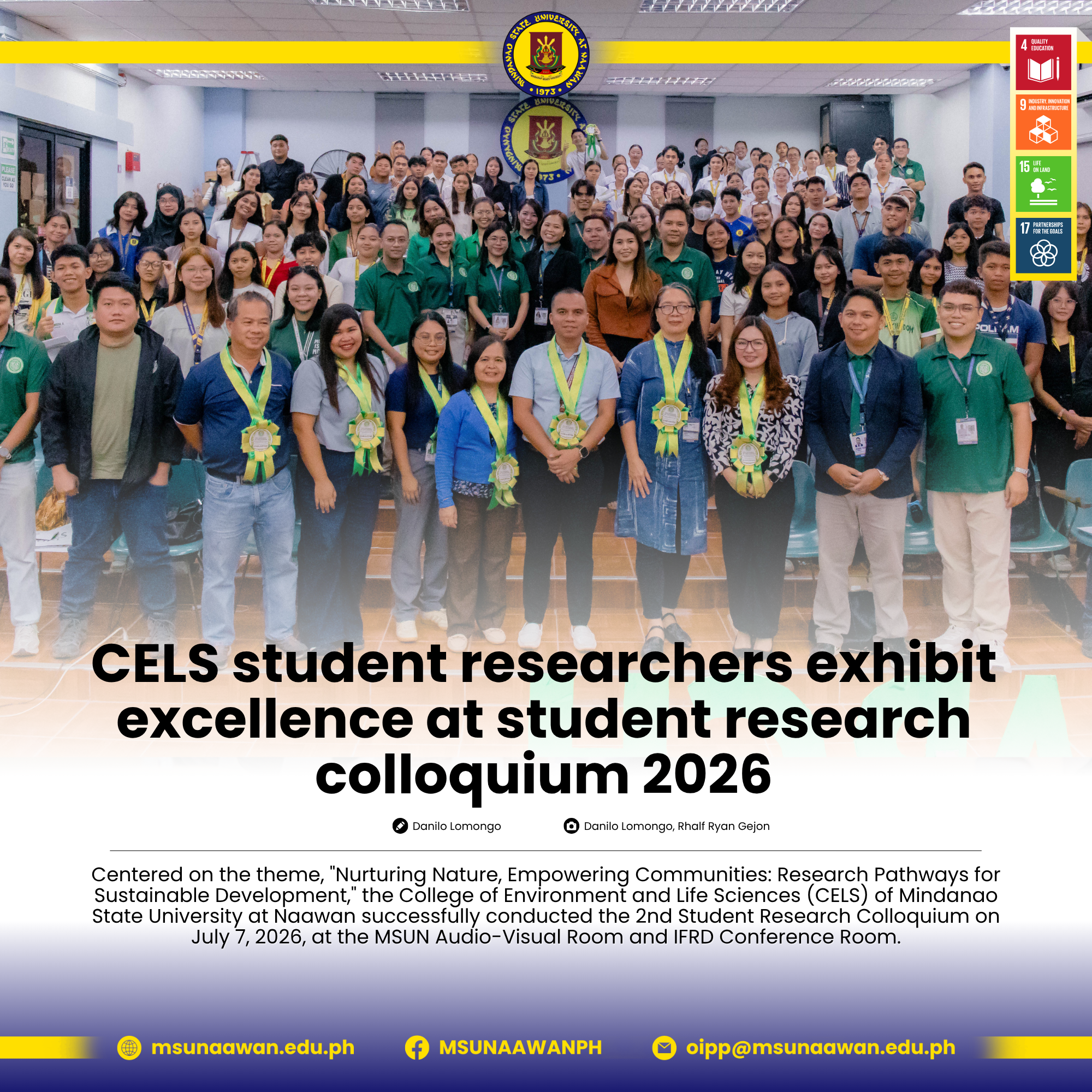
Centered on the theme, “Nurturing Nature, Empowering Communities: Research Pathways for Sustainable Development,” the College of Environment and Life Sciences (CELS) of Mindanao State University at Naawan successfully conducted the 2nd Student Research Colloquium on July 7, 2026, at the MSUN Audio-Visual Room and IFRD Conference Room.
The event gathered undergraduate student researchers, faculty members, research advisers, and evaluators in a celebration of scientific inquiry, academic excellence, and innovation. The colloquium featured oral research presentations and poster exhibits from students of the BS Environmental Science, BS Forestry, BS Agriculture major in Agronomy, and BS Agriculture major in Animal Science programs.
Through parallel presentation sessions and interactive discussions, student researchers showcased the outcomes of months of scientific investigation, highlighting research that addresses pressing environmental, agricultural, and community development concerns.
In his opening remarks, Asst. Prof. Ramon Francisco Q. Padilla emphasized that research serves as a meaningful instrument in addressing environmental challenges and creating a more sustainable future for communities. He encouraged students to make the most of the opportunity to share their work while expressing gratitude to the faculty advisers whose unwavering guidance, mentorship, and commitment have shaped not only the students’ academic success but also their professional values of excellence, integrity, and service.
In her keynote address, Zy D. Perpetua, MSc., a distinguished instructor of Mindanao State University at Naawan and a Department of Science and Technology – Accelerated Science and Technology Human Resource Development Program Scholar, reminded aspiring researchers that excellence begins with curiosity rather than perfection. She emphasized that research is a continuous learning journey founded on patience, honesty, humility, and the willingness to grow through questions and experiences. More importantly, she underscored that a researcher who creates lasting impact is not measured solely by intelligence, awards, or publications but by the ability to use knowledge to improve lives, protect the environment, and empower communities.
The colloquium also featured the ceremonial ribbon-cutting of the University’s four newly installed Interactive Television units at the Research Lobby. The addition of these modern learning technologies strengthens the University’s research facilities by fostering interactive discussions, academic presentations, and research dissemination.
Throughout the colloquium, open forum sessions followed each set of presentations, allowing evaluators to provide constructive feedback and recommendations that enhanced the students’ research outputs while cultivating critical thinking, scientific communication, and professional confidence.
The highlight of the colloquium was the recognition of outstanding student researchers for exemplary oral presentations and poster exhibits across the College’s undergraduate programs.
For the Oral Presentation Category, Hercly Asis Siega received the Best Thesis Paper Award for BS Environmental Science for “Unraveling Microplastics in the Surface Water of the Mid- and Lower Reaches of Talabaan River in Naawan, Misamis Oriental.” In BS Forestry, Clinton Jay Q. Don and Alleo O. Augusto earned the Best Thesis Paper Award for “Microhabitat and Species Importance Value of Woody Vascular Plants in Mt. Anggas, Misamis Oriental.” Representing BS Agriculture major in Agronomy, Algen F. Talisaysay received the Best Thesis Paper Award for “Agronomic Performance of Different Upland Rice (Oryza sativa L.) Varieties in Kapatagan, Lanao del Norte.” Meanwhile, Marry Gillian Paglinawan was recognized with the Best Thesis Paper Award for BS Agriculture major in Animal Science for “Physico-Chemical Characteristics of Meat from ItikPINAS (Anas platyrhynchos L.) Fed with Varied Levels and Forms of Mussel (Mytella strigata Hanley) Meal as a Partial Feed Replacement.”
For the Best Poster Exhibit Category, Rejgae S. Amabalong received the Best Poster Award for BS Environmental Science for “Influence of Land Use on the Riparian Landscape of Tubod, Iligan City: Basis for Management and Conservation Actions.” In BS Forestry, Cedric Ivan James Vidal and Rexanne J. Castillo earned the Best Poster Award for “Estimation of Net Carbon Sequestration of Selected Agroforestry Systems in Barangay Mapulog, Naawan, Misamis Oriental.” Earl C. Migriño received the Best Poster Award for BS Agriculture major in Agronomy for “Evaluation of Different Hydroponic Systems on the Growth and Yield Performance of Cherry Tomato (Solanum lycopersicum var. cerasiforme).” Meanwhile, Carlo S. Altes was recognized with the Best Poster Award for BS Agriculture major in Animal Science for “Growth Performance of Broiler Chickens (Gallus gallus domesticus L.) Fed Black Soldier Fly (Hermetia illucens L.) Larvae Meal Reared on Vegetable Waste and Fish Offal Substrate.”
Beyond recognizing academic excellence, the colloquium celebrated the dedication, perseverance, and scientific curiosity demonstrated by every student researcher throughout the research process. From conceptualizing research problems and conducting field and laboratory investigations to analyzing data and presenting evidence-based findings, each study reflected the University’s commitment to producing research that contributes to environmental conservation, sustainable agriculture, food security, and community development.
As the 2nd CELS Student Research Colloquium 2026 concluded, it reaffirmed the vital role of research as a catalyst for innovation, sustainability, and nation-building. Stretching far beyond the classroom, the studies presented embodied the potential of young researchers to generate knowledge, address real-world challenges, and contribute meaningful solutions that create lasting impact for both communities and the environment.