Mindanao State University at Naawan

November 2025

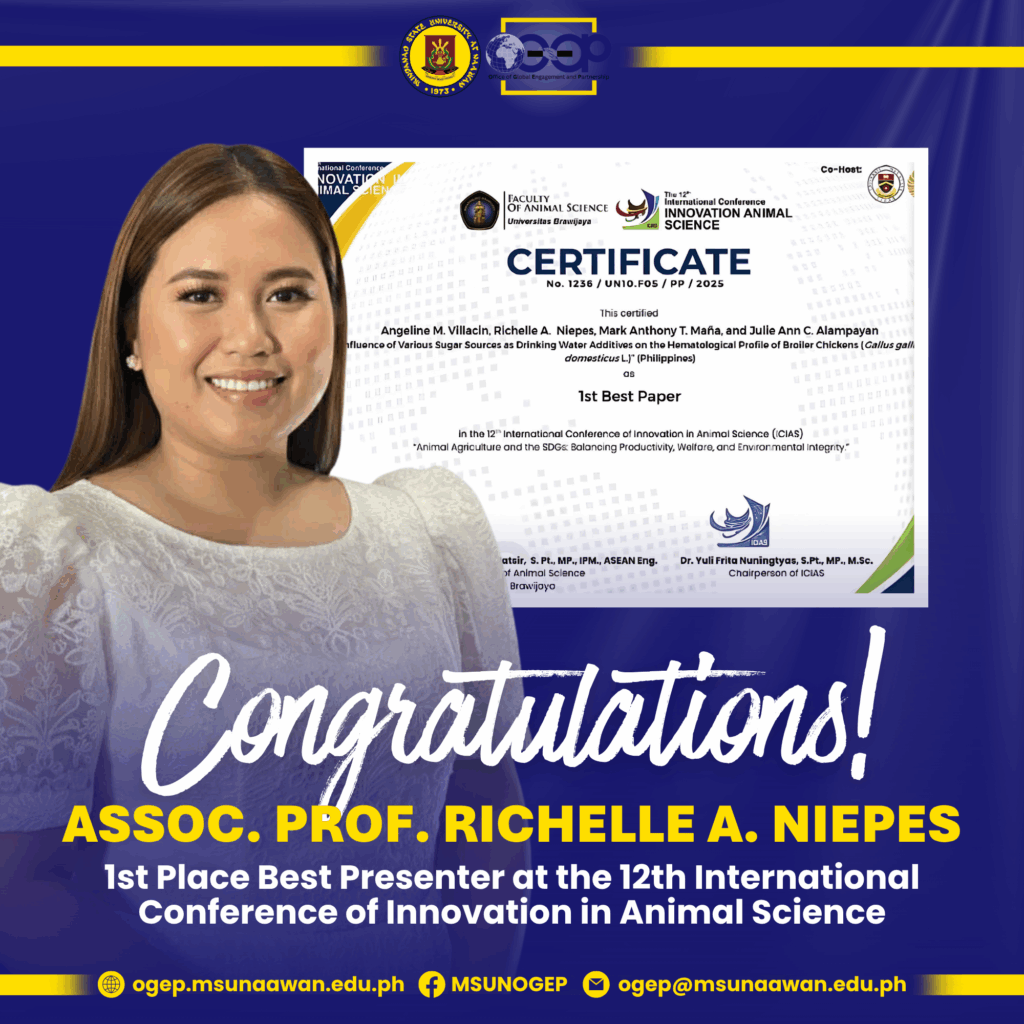
Faculty Researcher Wins Best Presenter at 12th International Animal Science Conference

Assoc. Prof. Richelle A. Niepes of the College of Environment and Life Sciences at Mindanao State University at Naawan was awarded 1st Place Best Presenter at the 12th International Conference of Innovation in Animal Science. The virtual conference was held via Zoom on November 5, 2025. The event was organized by Universitas Brawijaya, Indonesia, in partnership with Universiti Malaysia Sabah and Universitas Negeri Surabaya. It convened researchers and experts from Thailand, Taiwan, Indonesia, Ghana, Vietnam, and other participating nations to present innovative developments in the field. Selected proceedings from the conference are slated for publication in BIO Web of Conferences, a Scopus-indexed journal series. Assoc. Prof. Niepes presented the study titled, “Influence of Various Sugar Sources as Drinking Water Additives on the Hematological Profile of Broiler Chickens (Gallus gallus domesticus L.).” The research was co-authored by Ms. Angeline M. Villacin, Mr. Mark Anthony T. Maña, and Ms. Julie Ann C. Alampayan. The research examines the effects of alternative sugar sources as drinking water additives on the hematological profile of broiler chickens. The findings provide insights into improving poultry health, enhancing feed conversion efficiency, and potentially reducing production costs. The study also supports the identification of cost-effective nutritional supplements for small-scale and commercial poultry production, particularly in developing regions. This recognition for Assoc. Prof. Niepes and her team highlights their contribution to animal science research and reinforces MSU at Naawan’s commitment to producing relevant, high-impact research that supports agricultural innovation.

Faculty Researcher Wins Best Presenter at 12th International Animal Science Conference Read More »

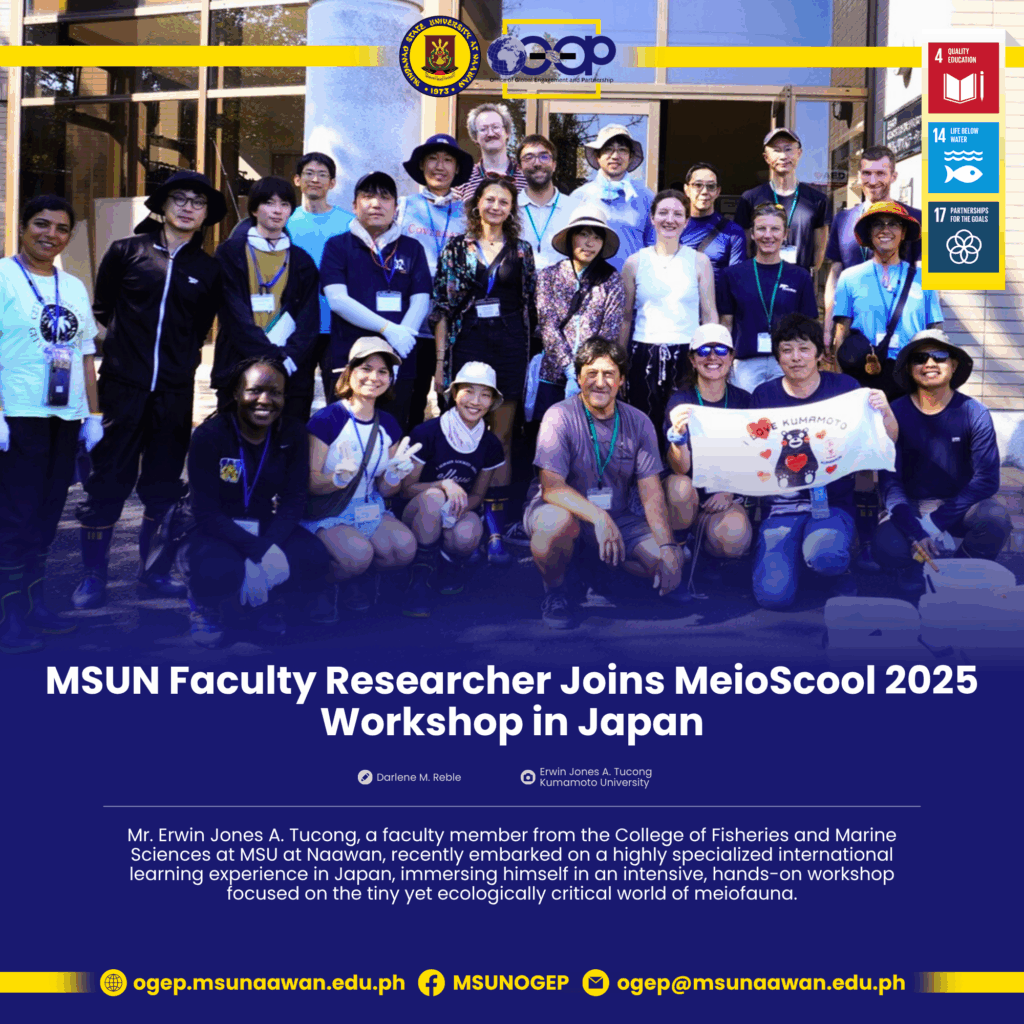
𝐌𝐒𝐔𝐍 𝐅𝐚𝐜𝐮𝐥𝐭𝐲 𝐑𝐞𝐬𝐞𝐚𝐫𝐜𝐡𝐞𝐫 𝐉𝐨𝐢𝐧𝐬 𝐌𝐞𝐢𝐨𝐒𝐜𝐨𝐨𝐥 𝟐𝟎𝟐𝟓 𝐖𝐨𝐫𝐤𝐬𝐡𝐨𝐩 𝐢𝐧 𝐉𝐚𝐩𝐚𝐧

Mr. Erwin Jones A. Tucong, a faculty member from the College of Fisheries and Marine Sciences at MSU at Naawan, recently embarked on a highly specialized international learning experience in Japan, immersing himself in an intensive, hands-on workshop focused on the tiny yet ecologically critical world of meiofauna. Mr. Tucong participated in the MeioScool 2025 International Workshop, held from October 6–9 at Kumamoto University’s Aitsu Marine Station in Amakusa, Japan. More than a series of lectures, the event served as a dynamic platform for emerging and established scientists to deepen their technical competence in meiofauna research, equipping participants with essential skills in taxonomy, sampling methodology, laboratory processing, and biodiversity assessment. The training gathered researchers and students from across the globe to exchange expertise on managing and understanding these microscopic organisms that play a vital role in marine ecosystems. The workshop began with an orientation at the Aitsu Marine Station before quickly transitioning to field activities. Participants collected sediment samples from both deep offshore and shallow coastal sites, aiming to investigate how variations in sediment type influence meiofaunal communities. These samples were subsequently processed and sorted in the laboratory, offering attendees a direct, hands-on encounter with real specimens and field data. On October 7, participants attended a lecture on copepod diversity and taxonomy led by renowned expert Dr. Pedro Martinez Arbizu. The session provided an in-depth look at one of the most abundant and diverse meiofaunal taxa. Afterward, the group conducted additional sampling at a low-tide beach, followed by laboratory analysis and microscopy of the newly collected specimens. The final two days featured a combination of advanced lectures and rigorous lab work. Topics included major meiofaunal groups such as nematodes, kinorhyncha, tardigrades, loriciferans, and foraminiferans, alongside sessions on molecular biology, advanced imaging techniques, and the application of scanning electron microscopy and ECOTAXA software for species documentation and identification. Between the expert-led sessions, participants worked individually and collaboratively to identify collected meiofauna under the microscope, reinforcing both their theoretical and practical learning. Beyond technical training, MeioScool 2025 fostered meaningful international collaboration and scientific exchange. Participants had the opportunity to interact with prominent meiofauna researchers and fellow trainees from various countries, building networks that can support future collaborative projects and research endeavors. For Mr. Tucong, this workshop serves as a significant milestone in his professional development as a marine researcher. The knowledge and skills he gained, particularly in specimen collection, taxonomic identification, and analytical techniques, will directly support ongoing and future research initiatives at MSU at Naawan. His enhanced expertise strengthens the university’s capacity to investigate marine biodiversity, contributes to a deeper understanding of local and regional ecosystems, and supports evidence-based conservation and management of coastal and marine environments. Moreover, his participation reinforces MSU at Naawan’s commitment to global engagement and scientific excellence, reflecting the institution’s dedication to nurturing researchers who can contribute to international discourse and research frontiers. The connections and collaborations initiated during the workshop will help open doors for joint studies, academic exchanges, and international partnerships in marine science. Mr. Tucong returns home equipped with sharpened fieldwork and taxonomic skills, ready to share his learnings with students and colleagues and support MSU at Naawan’s expanding role in marine biodiversity research, further advancing the university’s mission of generating knowledge that promotes sustainable development in aquatic ecosystems.

𝐌𝐒𝐔𝐍 𝐅𝐚𝐜𝐮𝐥𝐭𝐲 𝐑𝐞𝐬𝐞𝐚𝐫𝐜𝐡𝐞𝐫 𝐉𝐨𝐢𝐧𝐬 𝐌𝐞𝐢𝐨𝐒𝐜𝐨𝐨𝐥 𝟐𝟎𝟐𝟓 𝐖𝐨𝐫𝐤𝐬𝐡𝐨𝐩 𝐢𝐧 𝐉𝐚𝐩𝐚𝐧 Read More »

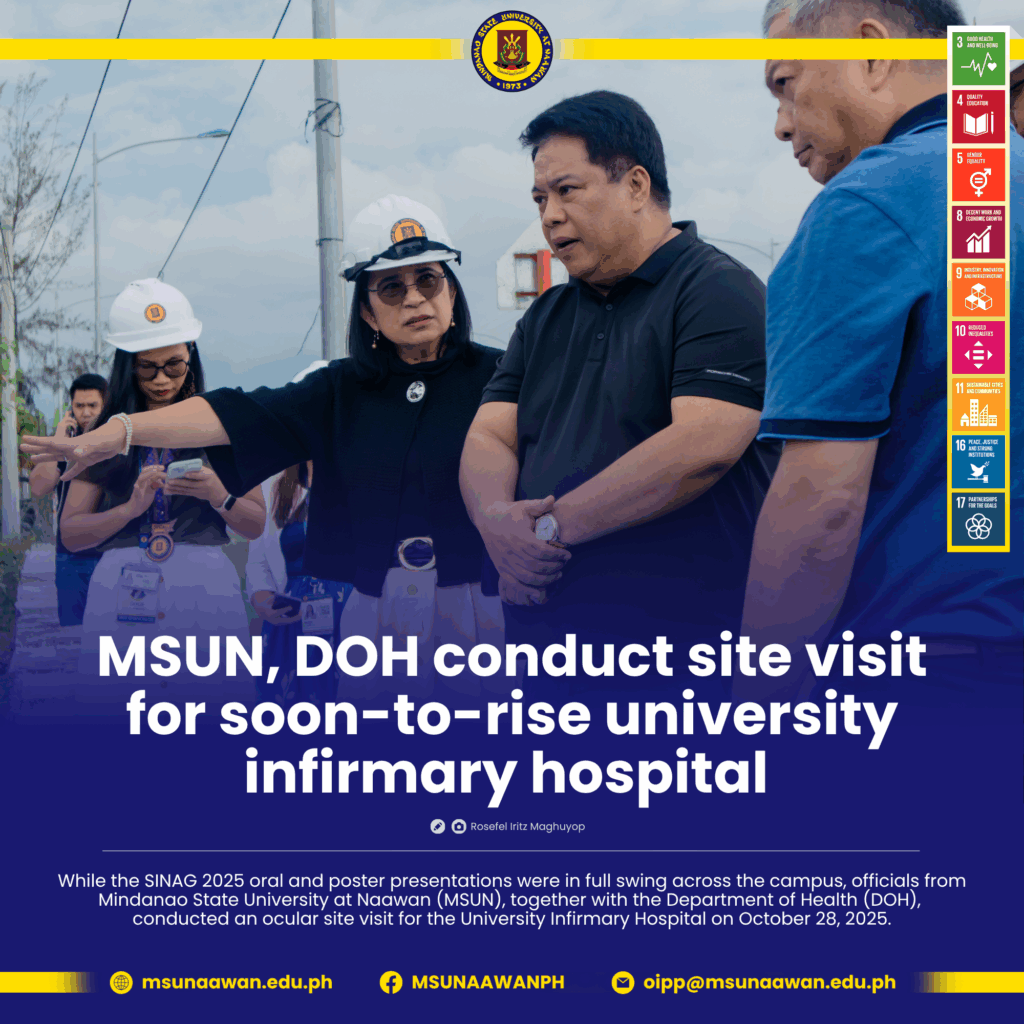
MSUN, DOH conduct site visit for soon-to-rise university infirmary hospital

While the SINAG 2025 oral and poster presentations were in full swing across the campus, officials from Mindanao State University at Naawan (MSUN), together with the Department of Health (DOH), conducted an ocular site visit for the University Infirmary Hospital on October 28, 2025. Joining the visit were DOH Health Facilities Enhancement Program Undersecretary Dr. Gregorio T. Murillo, Jr. and DOH Center for Health Development–Northern Mindanao Dir. Sulpicio Henry M. Legaspi, Jr., MD, MPH, FPSMS, CESO IV, alongside MSUN Chancellor Dr. Elnor C. Roa, Vice Chancellors Asst. Prof. Gergie A. Ambato, Assoc. Prof. Frederick B. Cabactulan, and Ms. Rhoda D. Perpetua, together with university engineers, architect, and project contractors. Funded by the Department of Health, this soon-to-rise facility marks a significant step toward strengthening campus healthcare services and advancing MSUN’s commitment to student and community well-being. Once completed, the infirmary hospital will serve as a vital hub for accessible and quality health care – not only for students, faculty, and staff, but also for surrounding communities – enhancing MSUN’s capacity to respond to emergencies, support public health initiatives, and promote a safer, healthier academic environment for all.

MSUN, DOH conduct site visit for soon-to-rise university infirmary hospital Read More »

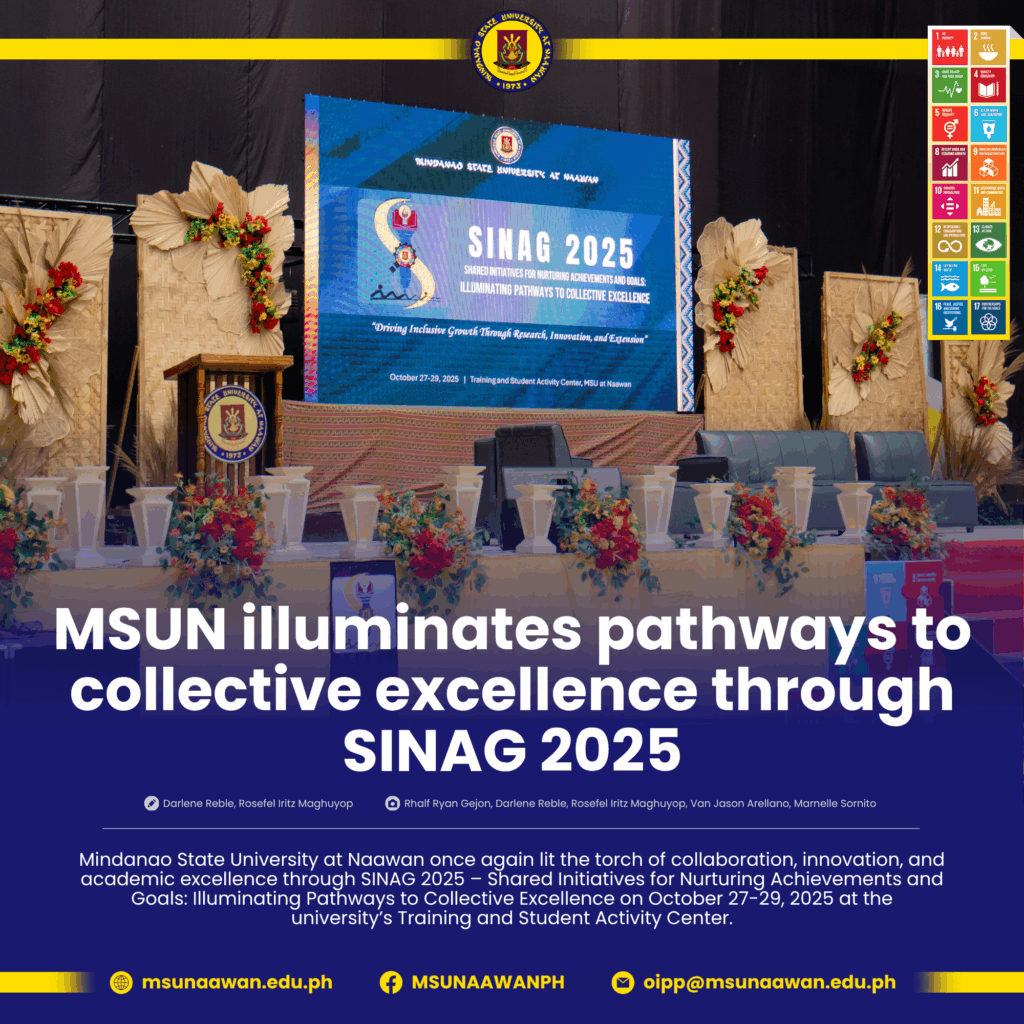
MSUN illuminates pathways to collective excellence through SINAG 2025

Mindanao State University at Naawan once again lit the torch of collaboration, innovation, and academic excellence through SINAG 2025 – Shared Initiatives for Nurturing Achievements and Goals: Illuminating Pathways to Collective Excellence on October 27-29, 2025 at the university’s Training and Student Activity Center.  Anchored on MSUN’s mission of providing transformative education, advancing research, and fostering sustainable community engagement, the three-day event was convened by faculty, researchers, students, and partner institutions to share insights and chart the course toward collective excellence. “Ang SINAG dili lang usa ka tinuig nga kalihokan; it is a symbol of our unity as one academic community —the Mindanao State University at Naawan, built upon our shared vision to serve, to innovate, and to inspire. This year marks the birth of a new tradition — what we now call SINAG,” delivered MSUN Vice Chancellor for Research, Innovation, and Global Engagement Dr. Rey Y. Capangpangan on his opening message. He added, “In the previous years, this gathering was known as the Agency In-House Review, but today, it takes on a new name and a deeper meaning. Thus, SINAG 2025 is born — a symbol of light, unity, and shared commitment to nurture achievements and goals that drive inclusive growth through research, innovation, and extension.” As MSUN’s Agency Annual In-House Review, SINAG 2025 served as a dynamic platform for reflection, recognition, and strategic alignment of the university’s programs and initiatives, celebrating milestones in research, development, and extension. At its core, SINAG 2025 embodies MSUN’s core values of being Mission-driven, Sustainable, United, and Nurturing, a reflection of its continuous pursuit of relevance and impact. Through plenary presentations, research colloquia, stakeholder forums, and exhibits, the event showcased the university’s role as a catalyst for innovation and inclusive growth in Mindanao and beyond. 𝙎𝙝𝙤𝙬𝙘𝙖𝙨𝙞𝙣𝙜 𝙄𝙣𝙣𝙤𝙫𝙖𝙩𝙞𝙤𝙣 𝙖𝙣𝙙 𝙎𝙘𝙝𝙤𝙡𝙖𝙧𝙡𝙮 𝙄𝙣𝙦𝙪𝙞𝙧𝙮 The inaugural day of SINAG 2025 commenced with a vibrant and forward-looking showcase of innovation through the official launch of research and extension e-posters and booth exhibits.  This dynamic display featured the groundbreaking work of Mindanao State University at Naawan’s various research centers, presented alongside key partner agencies like the Philippine Council for Agriculture, Aquatic and Natural Resources Research and Development of the Department of Science and Technology (DOST-PCAARRD)’s Regional Agri-Aqua Innovation System Enhancement (RAISE) program 10.  The exhibits served as a tangible representation of the university’s diverse and impactful research portfolio, highlighting critical advancements in environmental sustainability, innovative solutions for food security, and effective strategies for community empowerment. As the day progressed, the focus shifted to a rigorous intellectual forum with the Colloquium for Theses and Dissertations. This pivotal session provided a platform for MSUN’s own faculty and staff to present their advanced academic research, sharing the depth of their scholarly pursuits with colleagues and the wider community.  More than just a series of presentations, the colloquium stood as a powerful testament to the institution’s unwavering commitment to fostering a robust culture of inquiry.  By championing the continuous professional development of its academic community, MSUN reaffirms its dedication to cultivating an environment where scholarly excellence and intellectual curiosity thrive. 𝘼𝙙𝙫𝙖𝙣𝙘𝙞𝙣𝙜 𝙁𝙧𝙤𝙣𝙩𝙞𝙚𝙧𝙨 𝙤𝙛 𝙎𝙘𝙞𝙚𝙣𝙘𝙚 𝙖𝙣𝙙 𝘾𝙤𝙡𝙡𝙖𝙗𝙤𝙧𝙖𝙩𝙞𝙫𝙚 𝙍𝙚𝙨𝙚𝙖𝙧𝙘𝙝 The second day featured a series of plenary talks from distinguished international and national scientists whose expertise provided valuable insights into emerging frontiers of science and innovation.  Dr. Fernando P. Siringan, Academician at the National Academy of Science and Technology and Research Professor at the UP Marine Science Institute, opened the plenary with a compelling lecture titled “Submarine Groundwater Discharge: Their Significance in Marine Ecosystems.” His talk shed light on the often-overlooked role of submarine groundwater discharge in shaping coastal water quality, nutrient dynamics, and marine biodiversity, offering critical insights for sustainable coastal management and marine conservation. Dr. Meng Chuan Ong, Associate Professor at the Faculty of Science and Marine Environment, Universiti Malaysia Terengganu, followed with his presentation “Living Sensors: Investigating Pollution through Aquatic Organisms.” His study emphasized how aquatic organisms can act as natural indicators of environmental health, providing an innovative, nature-based approach to detecting and addressing pollution in aquatic ecosystems. Concluding the plenary series, Dr. Chandan Hunsur Ravikumar, Assistant Professor at the Centre for Nano and Material Sciences, Jain (Deemed-to-be-University), India, delivered his talk “Smart Sensing for Smarter Farms.” He showcased the transformative potential of nanotechnology in developing intelligent sensing tools for precision agriculture, highlighting how data-driven innovations can lead to more sustainable and efficient farming systems. The afternoon was dedicated to a dynamic series of parallel sessions. These sessions provided a valuable avenue for in-depth dialogue, allowing presenters to share completed studies with conclusive findings, discuss ongoing projects to receive formative peer feedback, and engage in one-on-one conversations through interactive poster presentations.  Moreover, this multifaceted format fostered a vibrant marketplace of ideas, encouraging robust knowledge exchange across various disciplines and allowing attendees to immerse themselves in topics most relevant to their expertise and interests.  Ultimately, these parallel presentations were crucial for building collaborative connections and refining scholarly work within the academic community. 𝙎𝙩𝙧𝙚𝙣𝙜𝙩𝙝𝙚𝙣𝙞𝙣𝙜 𝙎𝙮𝙣𝙚𝙧𝙜𝙮 𝙩𝙝𝙧𝙤𝙪𝙜𝙝 𝙎𝙩𝙖𝙠𝙚𝙝𝙤𝙡𝙙𝙚𝙧𝙨’ 𝙁𝙤𝙧𝙪𝙢 The final day of SINAG 2025 culminated in a powerful display of synergy between academia, government, and local communities, primarily through a landmark Stakeholders’ Forum.  The session was anchored by an inspiring plenary talk from Mr. Roberto “Ka Dodoy” Ballon Jr., a 2021 Ramon Magsaysay Awardee, titled “Abundance, Healthy, Clean, and Safe Environment: Coastal Community Cooperation and Conservation.”  By sharing his compelling, real-world story of successful grassroots conservation, he grounded the day’s discussions in tangible reality, setting a deeply inspirational tone for everyone present. His journey served as a powerful testament to the idea that community-led initiatives are not just a possibility, but a potent force for creating remarkable environmental and social impact.  This provided the assembled academics and government officials with a living, breathing model of success, illustrating how policies and research can translate into meaningful action and demonstrating that true, sustainable change often begins with the passion and cooperation of the community itself. Following his address, high-level representatives from key regional government agencies, including DOST, DICT, DSWD, BFAR, DENR, DOST-PTRI, NOMCARRD, DTI, and
MSUN illuminates pathways to collective excellence through SINAG 2025 Read More »

Scroll to Top